
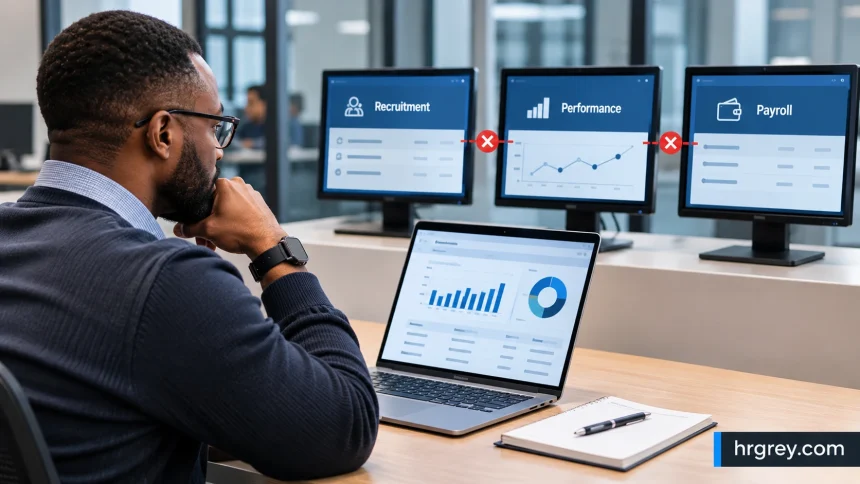
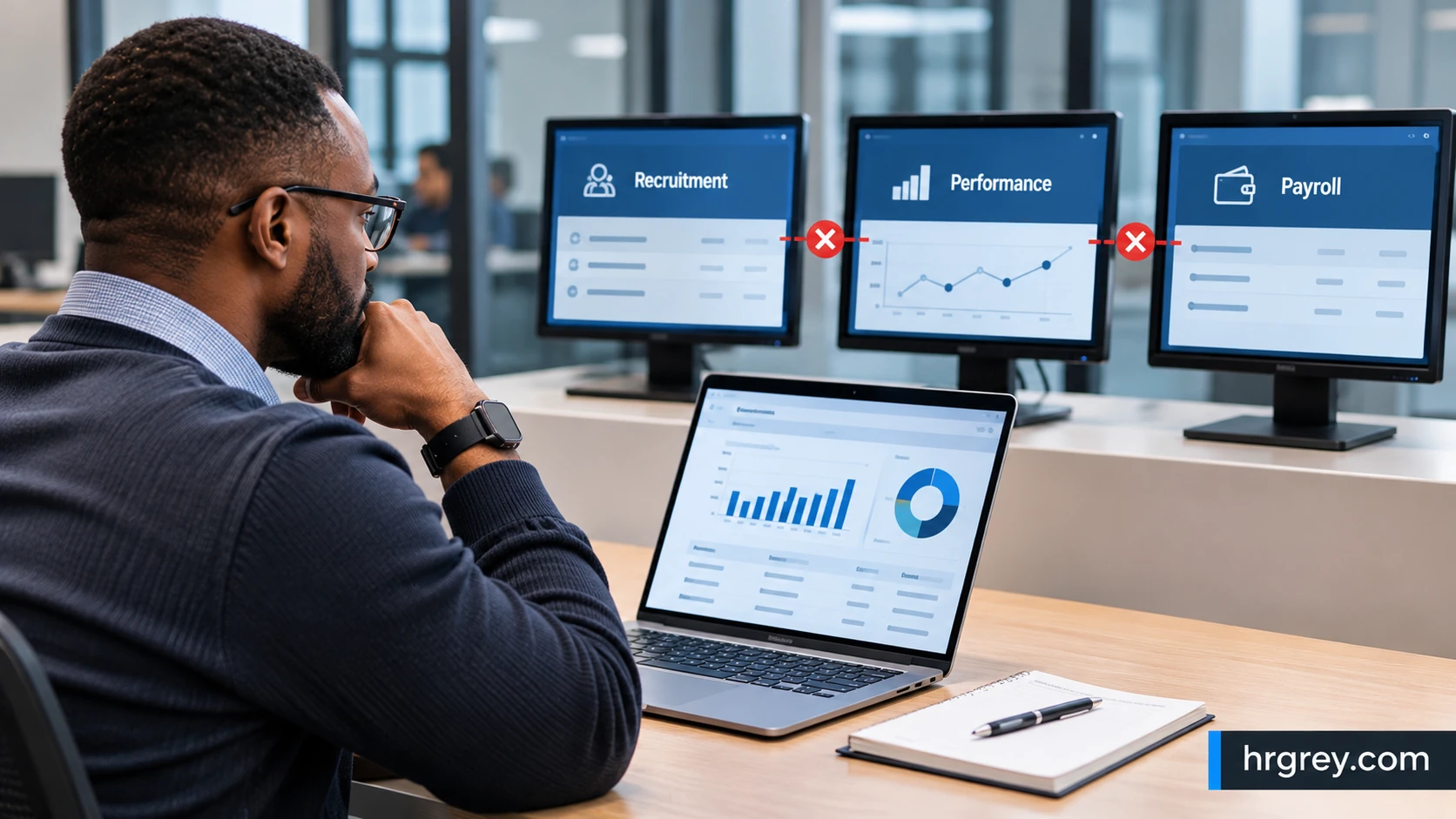
Only 42% of HR professionals say their organization’s HR technology systems are well integrated for data analysis. Another 26% say their organizations regularly combine HR data with information from other business functions.
The findings point to a problem that is becoming harder to ignore as organizations invest in workforce analytics. Companies have more employee information available than ever, but much of it remains trapped in separate applications. Recruitment data sits in one platform, payroll records in another, while performance reviews, training histories and employee engagement results are stored elsewhere.
Individually, these systems can provide useful information. Together, they should help organizations understand their workforce and make better decisions. But when they cannot communicate effectively, HR teams are left working with incomplete records, manually combining reports and struggling to establish connections between workforce activities and business performance.
The result is that many organizations are collecting workforce data without getting its full analytical value.
More HR technology has not necessarily produced better workforce insights
The growth of HR software has given organizations more ways to record and monitor employee information. Applicant tracking systems manage recruitment, human resource information systems maintain employee records, payroll platforms handle compensation, and learning management systems track training and development.
These applications often enter an organization at different times, selected to address specific operational needs. A recruitment team might choose an applicant tracking platform without considering how its information will connect with the company’s performance management system. Finance may operate payroll separately, while learning and development uses another application to monitor employee skills.
Over time, the organization accumulates several sources of workforce information without necessarily establishing a reliable way to combine them.
Korn Ferry’s 2026 Global Talent Analytics Survey illustrates the scale of the problem. Among 1,600 senior HR and business leaders surveyed across 10 countries, 84% said their organizations operated between three and 10 talent data platforms. Only 5% reported having fully connected talent data systems, while 68% described their integration as partial or minimal.
Having several applications is not automatically a problem. Organizations may need different tools for different activities. The difficulty begins when information cannot move reliably between them or when different departments use inconsistent definitions for the same workforce metrics.
Fragmented records make it harder to understand employee performance
One of the main advantages of people analytics is its ability to connect information across the employee lifecycle. Recruitment, onboarding, training, performance, compensation and retention are not isolated activities. Decisions made at one stage can influence outcomes at another.
Consider an organization trying to understand why employees recruited into certain roles leave within their first year. Recruitment records may show where those employees came from, but understanding their departure could require additional information about onboarding, compensation, training, management feedback and performance.
If these records are held in disconnected systems, HR may be able to calculate the turnover rate without identifying the workplace conditions associated with it.
The same limitation applies to workforce development. An organization may spend heavily on employee training but struggle to establish whether the investment improves performance, addresses skills shortages or prepares employees for internal promotion. Training records alone cannot answer those questions.
A 2023 systematic literature review on workforce analytics adoption identifies fragmented HR systems as an obstacle to collecting and combining workforce information. The researchers also highlight difficulties accessing cross-functional data and the organizational capabilities needed to make analytics part of regular decision-making.
Manual reporting takes time away from meaningful analysis
When systems do not integrate, HR teams often have to export information from individual applications and combine it manually. This can involve downloading spreadsheets, matching employee records, correcting inconsistent entries and checking whether different reports use the same reporting periods.
The workload becomes particularly difficult when reports need frequent updates. An employee headcount report might be accurate when prepared but quickly become outdated after new hires, departures or departmental transfers.
Research published in BMC Health Services Research in September 2024 provides a practical example. Researchers interviewed 14 people working across four Norwegian municipalities and found that none made extensive use of HR data for workforce planning or strategic HR decisions.
The study identified separate software applications for activities such as payroll, recruitment and employee records. HR professionals described the difficulty of combining information from these systems, with some relying on spreadsheets to perform analysis.
Although the research focused on municipal healthcare services in Norway, it illustrates a wider operational problem: collecting workforce information is not the same as making it usable. The researchers also identified weak data culture, limited analytical capabilities and poor coordination between HR and other departments as barriers.
When analysts spend much of their time preparing data, less time is available to investigate turnover patterns, assess workforce needs or evaluate whether HR interventions are producing results.
Disconnected data can weaken trust in HR recommendations
People analytics is useful only when decision-makers have confidence in the information being presented. Conflicting figures, missing records and inconsistent reporting methods make that confidence difficult to establish.
For example, HR might report one headcount figure while finance produces another because the departments use different employee classifications or reporting dates. If leadership cannot reconcile the figures, discussions about workforce costs, recruitment budgets and staffing requirements become more complicated.
Korn Ferry’s 2026 survey found that only 34% of respondents were confident that their talent insights were reliable. It also found that 71% relied on instinct rather than insights when making talent decisions. Furthermore, 55% said they relied less on HR when they did not trust the talent data.
These findings reveal a problem that goes beyond reporting efficiency. When workforce information cannot be trusted, HR’s ability to influence important business decisions becomes weaker.
Managers may continue relying on personal experience when deciding who should be promoted, which roles need additional staff or where training budgets should go. Experience and professional judgment remain important, but they become less dependable when reliable workforce evidence is unavailable.
The financial implications extend beyond the HR department
Disconnected systems can also make it harder to understand how workforce decisions affect organizational performance.
Labour costs, productivity, employee skills, staffing levels and operational results are closely related. However, HR cannot properly examine those relationships when its information remains separate from finance, operations and other business data.
A business trying to understand the cost of excessive overtime, for instance, may need to compare payroll records with staffing levels, employee absence and departmental workloads. Without those connections, management may see the additional expenditure without identifying the workforce conditions contributing to it.
Korn Ferry’s research found that 99% of surveyed leaders believed disconnected talent data had a negative financial impact on their organizations. More than 80% estimated that the cost amounted to at least 3% of total payroll. These are respondents’ estimates rather than independently measured financial losses, but they show how seriously senior leaders view the problem.
The consequences can also appear in workforce utilization. In the same survey, 31% of leaders said more than a quarter of their workforce was underutilized. Without a connected view of employee skills, experience and current responsibilities, organizations may struggle to identify people whose capabilities could be better used in other roles.
Integration needs to go beyond connecting software
Connecting HR applications is an important starting point, but technology alone will not resolve every problem. Information must also be accurate, consistently defined and accessible to the people responsible for making workforce decisions.
Organizations need common standards for employee records, job titles, departmental structures, headcount and turnover calculations. Without these standards, combining information from different platforms can produce misleading results even when the technical integration works correctly.
A shared data warehouse or another properly designed analytical environment can help bring information from recruitment, payroll, performance and learning systems into one place. Connections with finance and operational data can then provide a broader picture of workforce costs and organizational performance.
HR also needs to work closely with IT, finance and business intelligence teams. Each department may hold information that helps explain workforce outcomes, but clear responsibilities and appropriate access controls are necessary when employee data is shared.
Just as importantly, analytics should address actual business questions. Organizations should be able to examine whether recruitment sources produce employees who stay longer, whether training improves job performance and which workforce conditions are associated with rising turnover.
These questions give data integration a clear purpose. They also make it easier to assess whether improved analytics is leading to better decisions rather than simply producing more dashboards.
People analytics needs reliable connections to deliver business value
The challenge facing HR is no longer simply collecting enough information about employees. Organizations must be able to connect that information, understand what it reveals and use the findings to inform decisions.
Disconnected HR systems leave important relationships hidden. They make routine reporting more difficult, limit the ability to investigate workforce problems and prevent HR from presenting a consistent picture of employee capability, performance and organizational needs.
Replacing every existing HR application may not be necessary. In many cases, better integration, consistent data standards and stronger collaboration between departments can make existing systems more useful.
As organizations continue investing in people analytics, the quality of their underlying data infrastructure will influence how much value they can extract from those investments. Without reliable connections between workforce information and wider business data, even sophisticated analytics tools will struggle to provide the complete picture that decision-makers need.